
Band D runs from £2,354.39 in Alderley to £2,635.97 in Stroud town. Every band A to H, what each precept costs you, and the parish that raised its precept 482%.
There is no single council tax bill in the Stroud district. The district has 54 parish and town councils, and all but two of them add a precept of their own on top of the same three charges. The gap between the cheapest parish and the dearest is £281.58 a year at band D.
The council publishes the full table, but only as a spreadsheet exported to PDF, and one of its columns is too narrow to print the number in it. Everything below was read out of that table and the council tax setting report on 1 September 2026.
The bill everyone pays before the parish precept
Two parishes in the district, Alderley and Owlpen, set no precept at all. Their residents pay the base charge and nothing more, so this is the floor for the whole district in 2026/27:
| Band | 1991 value | Charge |
|---|---|---|
| A | Up to £40,000 | £1,569.59 |
| B | £40,001 to £52,000 | £1,831.20 |
| C | £52,001 to £68,000 | £2,092.79 |
| D | £68,001 to £88,000 | £2,354.39 |
| E | £88,001 to £120,000 | £2,877.58 |
| F | £120,001 to £160,000 | £3,400.79 |
| G | £160,001 to £320,000 | £3,923.98 |
| H | Over £320,000 | £4,708.78 |
A disabled band reduction takes a band A property down to £1,307.99. (Stroud District Council, Council Tax Rates 2026/27; Council Tax bands)
Where the money actually goes
The district council keeps a tenth of it. At band D:
| Precept | Band D | Change on 2025/26 |
|---|---|---|
| Gloucestershire County Council | £1,763.46 | +4.99% |
| Gloucestershire Police | £340.58 | +5.74% |
| Stroud District Council | £250.35 | +2.99% |
| Base total | £2,354.39 |
The county’s rise is two separate things bolted together: a 2.99% council tax increase and a 2.00% adult social care levy. The adult social care element alone is £294.91 of a band D bill, more than the district council’s entire share.
The police precept rose fastest of the three, at 5.74%. (Stroud District Council, Council Tax Setting 2026/27)
Each precept broken down across every band:
| Band | County | Police | District |
|---|---|---|---|
| A | £1,175.64 | £227.05 | £166.90 |
| B | £1,371.58 | £264.90 | £194.72 |
| C | £1,567.52 | £302.74 | £222.53 |
| D | £1,763.46 | £340.58 | £250.35 |
| E | £2,155.34 | £416.26 | £305.98 |
| F | £2,547.22 | £491.95 | £361.62 |
| G | £2,939.10 | £567.63 | £417.25 |
| H | £3,526.92 | £681.16 | £500.70 |
The parish precept is what makes your bill different from your neighbour’s
Parish and town councils raised £6,608,926 between them for 2026/27, an average band D of £136.97. That average went up 9.96% in a year, three times the district council’s own increase.
The spread underneath the average is wide. These are the band D parish charges in the district’s main towns and villages, and the total band D bill each produces:
| Parish or town | Parish band D | Change | Total band D bill |
|---|---|---|---|
| Stroud | £281.58 | +15.49% | £2,635.97 |
| Wotton-under-Edge | £270.33 | +9.90% | £2,624.72 |
| Nailsworth | £262.19 | +16.22% | £2,616.58 |
| Dursley | £256.81 | +15.06% | £2,611.20 |
| Kingswood | £252.26 | +8.00% | £2,606.65 |
| Berkeley | £223.61 | +7.90% | £2,578.00 |
| Stonehouse | £185.79 | +5.07% | £2,540.18 |
| Cainscross | £179.94 | +12.85% | £2,534.33 |
| Slimbridge | £158.98 | +7.00% | £2,513.37 |
| Horsley | £143.57 | +14.68% | £2,497.96 |
| Minchinhampton | £104.05 | +3.02% | £2,458.44 |
| Cam | £101.46 | +3.45% | £2,455.85 |
| Chalford | £95.17 | +5.43% | £2,449.56 |
| Rodborough | £85.01 | +5.90% | £2,439.40 |
| Painswick | £80.87 | +3.91% | £2,435.26 |
| Alderley and Owlpen | £0.00 | 0.00% | £2,354.39 |
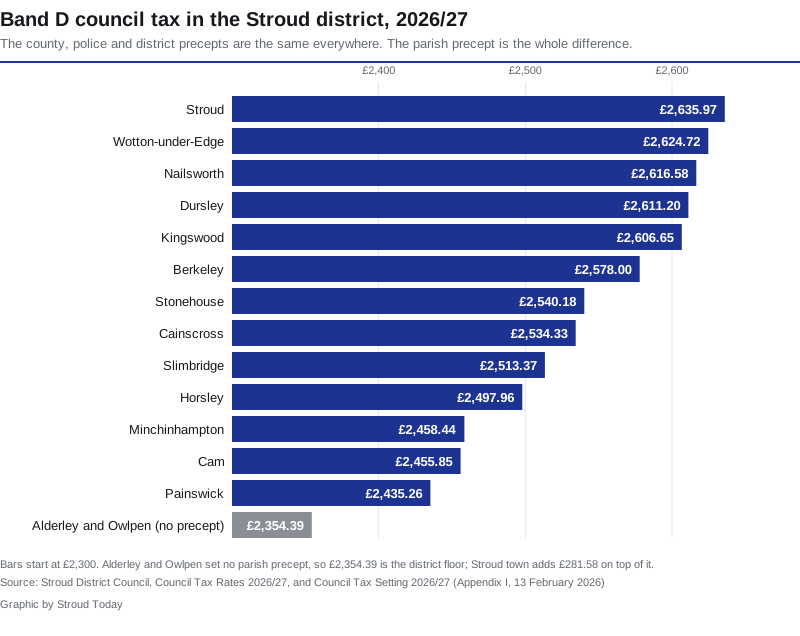
Stroud town has both the highest parish charge and one of the biggest rises. Its precept of £1,242,465 divided by a tax base of 4,412.46 gives £281.58 per band D property, 15.49% more than last year.
The number the council’s own table cannot print
Stroud Town Council’s precept does not appear in the district’s published rates table. In
the row for Stroud, the precept column reads #######, the symbol a spreadsheet
prints when a figure is too wide for its column. Stroud is the only parish whose precept
runs to seven digits, so it is the only one the table hides.
The figure, £1,242,465, is in the council tax setting appendix that went to full council on 13 February 2026. If you want it, you have to know that document exists. (Council Tax Rates 2026/27; Council Tax Setting 2026/27)
Four parishes that went the other way, and one that went up 482%
Not every parish raised its precept.
- Coaley cut its band D charge 2.62%, to £51.53
- Uley cut 2.15%, to £60.64
- Randwick and Westrip cut 0.65%, to £31.60
- Alkington held flat, at £30.22
At the other end, Eastington’s band D parish charge rose 482.83%, from a low base, to £46.28. Its precept is £30,000. The council’s own note explains why the figure looks strange: it “has been updated from the previously published estimated figure, following their meeting on 12 February 2026”, eight days before the district set its tax.
Two others rose sharply: Stinchcombe up 38.80% to £66.64 and Longney and Epney up 28.30% to £44.33. Both are small parishes where a modest cash increase moves the percentage a long way. Whiteshill and Ruscombe rose 16.47%, to £105.40.
How to check your own band, and how to challenge it
Stroud District Council does not set your band and cannot change it. The Valuation Office Agency does, using what the property was worth on 1 April 1991.
Check your band free at gov.uk/council-tax-bands. If you think it is wrong, the route is the council’s band appeals page, which passes you to the VOA.
Before you appeal, be clear that a challenge can move a band in either direction, and it moves it for the property, not for you.
Discounts, premiums and support
Single person discount, 25%. Available if you are the only adult over 18 living there, at your sole or main residence. Tell the council when that stops being true: “You may have to pay a fine if you don’t tell us.” (Single person discount)
Students. A property occupied only by full-time students is exempt. Two adults where one is a full-time student gets 25% off. If your child has left for university and you are now the only adult, you get the 25% sole occupancy discount, because the council treats their term-time address as their main home. (Student exemptions)
Empty property. Unoccupied and unfurnished gets 25% off for up to six months, then the full charge. A property under major structural repair gets 25% off for up to twelve months. After that the premiums start, and Stroud tightened them last year: since 1 April 2025 a property empty and unfurnished for one year or more carries a 100% premium, a 200% charge. It used to take two years. (Empty properties)
Second homes. Furnished, nobody’s main residence, no discount, and a 100% premium since 1 April 2025. The council made that determination at full council on 22 February 2024, for the whole district. (Second homes)
Council tax support. Stroud continues to award up to a maximum of 100% in support, which is more generous than the many councils that cap working-age claimants well below full relief. You cannot claim with capital or savings over £16,000, and most full-time students are excluded, though a non-student partner may claim. A second adult on a low income who is not your partner can bring a reduction of up to 25% through second adult rebate. (Council Tax Support Scheme 2026/27; Council tax support)
One more thing worth knowing
The government decided in July 2026 that Stroud District Council would be abolished in April 2028 and replaced by a single Gloucestershire unitary, which would merge the district and county lines on your bill. That decision was paused for review on 7 September 2026, so nothing about your bill is changing on a known date. The parish precept, the part that varies most, is the one least affected either way.
More Stroud local information: bin collection days, parking in Stroud and roadworks and travel.
Have your say